
How to Search Criminal Dockets
Start with the statewide eCourts Portal. Pick Smart Search. Type in a case number if you have one. Fall back on a permitted name or business search if you do not. The Portal covers every county in the eCourts environment. That reach cuts both ways: before you call a hit the right criminal matter, confirm it lists Cleveland and that the case number matches.
Results open into a Case Summary. That is the Portal's name for its organized public view of a case. Depending on access, it can show case information, Case Events, hearings, dispositions, and financial information. Treat it as a finding tool. It is not a certified copy, and it may hide filings or restricted items.
- Open Portal Smart Search and enter the complete case number if it is known.
- For a name search, open Advanced Filtering Options and select Cleveland as the location.
- Choose the published Criminal Actions category when a case-type filter is needed.
- Check the county, status, and number in the result before opening its Case Summary.
- Use the clerk for a public file, certification, or clarification when the online view is incomplete.
Cleveland County Criminal Actions Filter
Narrow the search before you open anything. On the Portal, Criminal Actions sits among the published case-type categories, next to Civil Actions, Estates, and nonconfidential Special Proceedings. Stack that filter with a Cleveland location, a case status, and a sensible filing-date range. A common-name search gets far more precise this way. Still, a search that returns nothing does not settle the question.
The Portal's fields run only as deep as what the Judicial Branch publishes. Begin with a number, party name, or business name. Then refine from there. You cannot invent a category. A broad statewide name list is never a Cleveland docket list.
| Portal field | Cleveland criminal use | Limit |
|---|---|---|
| Case number | Most direct way to target one case. | Historical formats can vary. |
| Location | Select Cleveland after a name search. | Location does not make restricted data public. |
| Case type | Select Criminal Actions when appropriate. | Use only the published category. |
| Filing-date range | Reduce a large statewide result set. | A range can omit an older filing. |
Note: A narrow Cleveland search trims false matches. It still cannot replace checking the case number and the visible case status yourself.
Cleveland County Criminal Case Numbers
A complete number is the safest key to a Cleveland County criminal docket. Portal guidance lays out the general shape. It starts with a two-digit year. Case-type letters follow. Then comes a six-digit sequence and a three-digit county identifier. Cleveland calendar documents carry the county suffix -220. So a pattern like YY-CR-######-220 is a reading aid only. No promise exists that every record, old or current, displays the same way.
Read the number alongside the court heading and case status. The county suffix helps separate a Cleveland listing from another county's record. Never rebuild a number from a city name. The same goes for an allegation or a guessed charge code. If a notice or citation shows a number, use that exact value first.
What a Criminal Docket Shows
Open a Cleveland Case Summary and you get a map of the case. It gathers the case identity, assignments, and parties. Charges or causes of action may appear where displayed. Case Events, hearings, dispositions, and financial information complete the picture. Every field does its own job. A hearing line marks a scheduled court event. It does not tell you what happened when the case was called. And a charge label is never a final finding on its own.
The Portal FAQ spells out which Case Summary sections exist. The clerk holds the official county file. When you need to confirm an important document or a final result, use the docket entry to name the item. Then ask the Clerk of Superior Court for the public record that is available.
| Case number | Identifies the case and helps confirm Cleveland location. |
|---|---|
| Case Events | Recorded procedural activity, read with dates and related orders. |
| Hearings | Scheduled date, time, courtroom, and other visible setting details. |
| Dispositions | Recorded resolution information where the Portal makes it available. |
| Financial information | Visible financial data; eligibility for online payment is a separate issue. |
Cleveland County Criminal Case Events
Case Events are the Portal's closest public version of a running criminal docket history. Filings, hearings, orders, and other procedural steps can all appear there. One short label rarely tells the whole story, though. It needs its date, the entries around it, and any order the court issued. A single line cannot tell you why the court acted. Nor can it show what legal effect an entry carries.
Three plain terms keep the record separate from any prediction. A disposition is a recorded manner of resolution. A continuance postpones the case to a later setting. A hearing is a scheduled proceeding, and it does not reveal the outcome. Keep those distinctions in mind. Read the visible Case Summary beside a calendar file with them.
- Case Event
- A recorded procedural occurrence, such as a filing, hearing, order, or other court action.
- Disposition
- The recorded way a charge or case was resolved, when the field is available.
- Continuance
- A scheduled setting moved to another date or session.
Note: Cleveland County criminal Case Events give you a procedural trail, not the full text of every filing or order.
Stages on a Criminal Docket
Criminal cases rarely follow one fixed script. Still, the Cleveland criminal docket often traces a familiar arc: filing or charging activity first, an initial setting next, then later hearings or pretrial work, and a recorded disposition if the case reaches one. Some matters take an appeal path or pick up a new setting after a continuance. Read the docket in date order. It records what has happened, not what happens next.
Which court handles the case shapes the path too. Misdemeanors, infractions, and traffic matters start in District Court. Felonies travel the Superior Court track. A District Court criminal appeal can open a second path in Superior Court, so confirm the court heading on each listing before assuming the first one is the only case record.
Docket flow: Filing or charge → initial setting → hearing or pretrial activity → plea or trial → disposition → sentencing when ordered.
Cleveland County Criminal Calendar Files
The Cleveland criminal calendar lays out the sessions a court expects to hold. Each file can carry a court heading, a session date and time, and a courtroom at the Cleveland County Courthouse. A case number, attorney or role columns, and a CHARGE column can appear too. That helps you find an upcoming setting. It does not replay the full Case Events history.
Read the CHARGE column with care. A code or label there names what the session will address, nothing more. It is not an outcome. It is not a certified charge. And it is not proof that a hearing took place, either. Treat the date and courtroom as planning tools. Then check close-in changes through Portal, the clerk, or the court's own instruction.
Cleveland County Criminal Court Paths
Cleveland County runs one unified General Court of Justice with three working parts. Superior Court takes the felonies. District Court handles misdemeanors, infractions, traffic matters, and many preliminary criminal proceedings. Magistrates do the statutory preliminary work, such as certain warrants, bonds, and first appearances. The Clerk of Superior Court keeps the county's records.
The legislature's G.S. 7A-271 sets out Superior Court criminal jurisdiction in official terms. For a Cleveland reader, the payoff is practical. The court heading on an entry tells you which track a docket item belongs to, and Portal stays the common public search route for visible trial-court records.
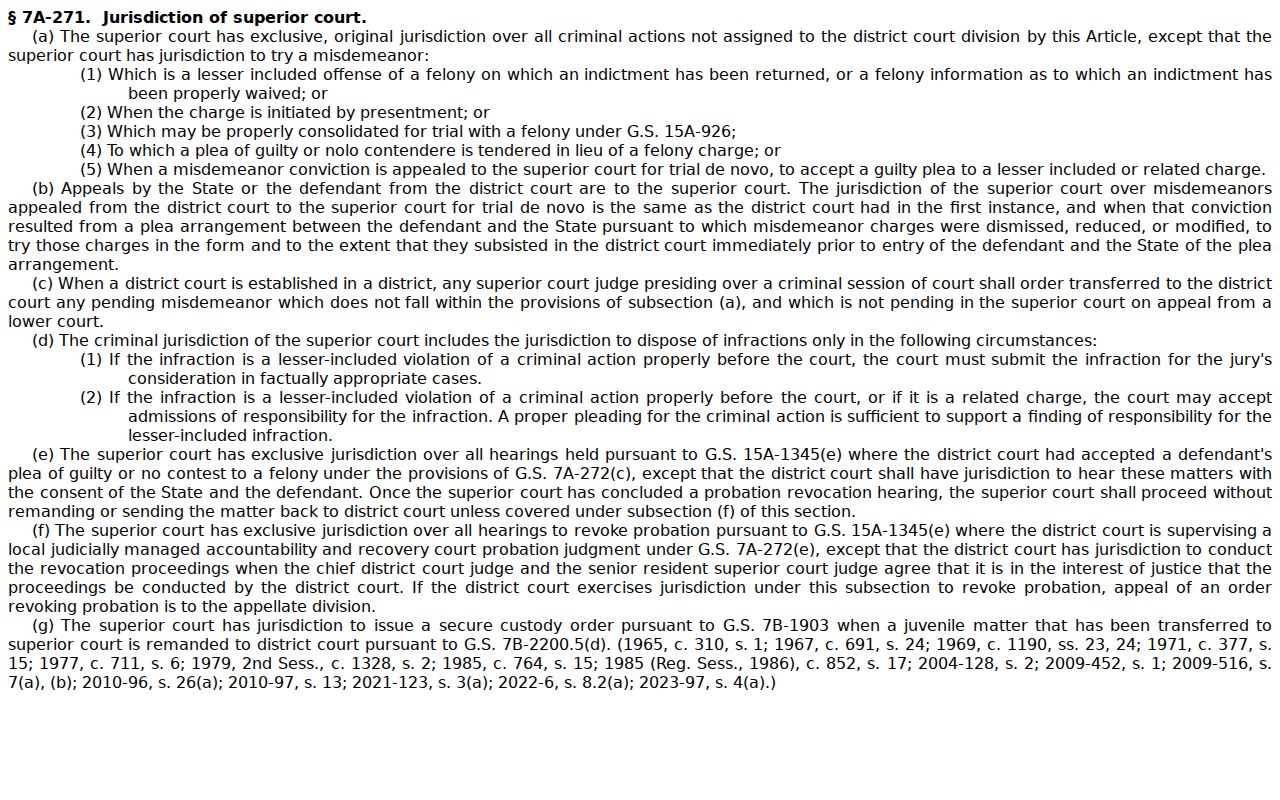
The statute draws the division lines, but it does no more than that. A calendar entry is still not a finding, and an arrest record is not a docket history.
Which Court Holds Criminal Dockets
One unified clerk office holds the trial-court records for Cleveland County. It covers Superior Court, District Court, and the magistrate channels all at once. So there is no separate civil and criminal clerk system to track down first. What still matters is the court division shown on a record. That division tells you where a hearing or an appeal belongs.
Local administration runs through District 39. That arrangement may show up in court-administration material. It never moves a Cleveland case file to a different clerk. The local clerk at the county courthouse is the record route for any Cleveland filing. The Judicial Branch's District Court overview gives the official statewide description of the court. That court handles Cleveland misdemeanors, infractions, and many preliminary criminal proceedings.
That statewide description helps you tell the two apart. One is the criminal docket track a case travels; the other is the unified clerk office that keeps the local record channels.
| Cleveland court path | Typical criminal role | Record route |
|---|---|---|
| Superior Court | Felony track and eligible criminal appeals. | Portal for visible data; clerk for the official file. |
| District Court | Misdemeanors, infractions, traffic, and preliminary matters. | Portal and the same Cleveland clerk office. |
| Magistrate | Statutory preliminary criminal functions. | Clerk remains the docket-record route. |
Cleveland County Criminal Clerk Access
When Portal comes up empty or lacks a document, go to the clerk next. State court-record guidance allows public criminal case information to be searched at self-service terminals. Those terminals sit in a clerk office. Need a plain copy, a certified copy, or word on whether a court record exists? The clerk-held file is the right route for all three.
The office sits in the Cleveland County Courthouse. Call ahead before a long trip. That matters if a copy, certification, or urgent setting is at stake. Staff can explain the public record route and current office process. They cannot give legal advice on a case.
Cleveland Clerk of Superior Court
100 Justice Place
Shelby, NC 28150
704-476-7800
Note: A clerk-terminal search can locate public case information, but sealed, confidential, or otherwise restricted material stays restricted.
Cleveland County Criminal Hearing Checks
Hearing questions get their own Portal tool. Search Hearings stands apart from Smart Search. Its published criteria cover case number, party or business name, attorney name, attorney bar number, judicial officer, and courtroom. Use it to spot an expected setting. The Cleveland criminal calendar supplies the county's public session documents.
Put the pieces together: court date, court heading, session time, and courtroom. Two cautions from the Portal FAQ. Virtual-hearing status does not appear in these results. Any calendar can be continued or reset. If a setting affects travel, a filing, or a required appearance, confirm it with the Cleveland clerk or the current court instruction.
Public Access and Sealed Criminal Dockets
North Carolina's Public Records Law, Chapter 132, works beside court-specific access rules. For Cleveland criminal dockets, the direct rule is G.S. 7A-109: the clerk maintains court records, files, dockets, and indexes, and opens them to public inspection during normal office hours unless law bars access. Portal widens the window with visible Case Summary information. It does not replace the official file.
Not every criminal record is public. The Portal FAQ says sealed and confidential records stay hidden from Portal users. A nonresult can flow from a county or spelling issue, processing lag, a restricted category, or simply no record. Treat it as none of those being proof. Do not read it as evidence a record lacks existence, and do not chase workarounds.
Access rules: G.S. 7A-109 identifies the clerk’s record-maintenance and public-inspection duty.
G.S. 132-6.2 addresses copy media, actual duplication cost, certification, and large requests.
Portal access guidance confirms that sealed and confidential records are not public Portal results.
Note: Cleveland public access starts with the clerk's record duty. Each record's own statute, rule, or seal order controls any restriction on it.
Cleveland County Criminal Access Limits
Some limits apply to any court docket search. Juvenile records are confidential under G.S. 7B-3000. Portal guidance also flags certain restricted categories. These include unreturned warrants, protected-order information, sealed material, and confidential data. Seeing one public event does not unlock a related restricted document. A file that will not open will not tell you why.
Treat the statute's public text as a boundary marker, not a workaround. A person who believes they qualify for nonpublic material must go through the proper court or clerk process. Everyone else should ask only for the public portion of a Cleveland record, if one exists.
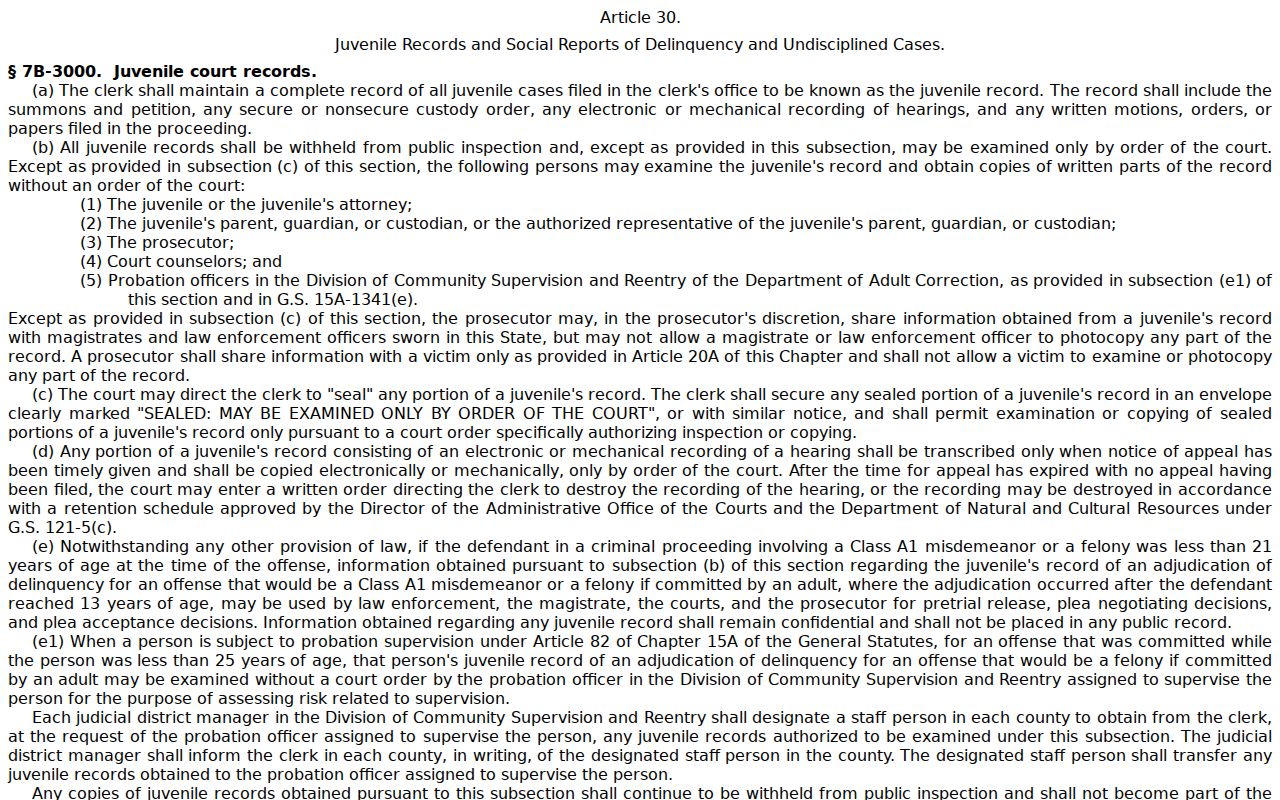
Honoring the limit keeps a Cleveland County criminal docket search honest. You stay on public court records, court dates, and understanding the case.