
Traffic Court Records in Cleveland County
Traffic cases in Cleveland County run through North Carolina's trial-court system. Shelby, Kings Mountain, Boiling Springs, Belwood, and Kingstown keep no municipal court docket of their own. The real route runs through the Cleveland District Court and the Clerk of Superior Court. Statewide services back it up for search, hearings, and payments.
On the court side, a traffic record can list several items. These include the case identity, the scheduled setting, Case Events, a public disposition, and financial details where available. That record is distinct from a calendar. A calendar only lays out planned sessions. The citation remains your first stop. It carries the county of charge, court date, case or citation number, and any waiver information.
Cleveland County Traffic Cases Start in District Court
Traffic and infraction cases in Cleveland County begin on the District Court track. North Carolina puts misdemeanors, infractions, and traffic matters in District Court, and the Clerk of Superior Court keeps the county's trial-court records through the unified clerk system. A District Court result can later be appealed to Superior Court. Even so, the original court record belongs with the Cleveland District Court and clerk route.
This matters most when a ticket was written in or near a city. The issuing location does not create a city-court docket. The county of charge and the court named on the citation decide where the appearance, the clerk transaction, and the local case record belong.
How to Look Up a Traffic Ticket
Begin with the citation, then verify the court record through the state and Cleveland channels. The eCourts Portal offers Smart Search by case number or permitted name, Search Hearings for date questions, and eligible payments. The Judicial Branch's Traffic Violations guidance points to Citation Services for online waiver, reduction, or dismissal options.
- Read the citation for its county of charge, court date, citation or case number, charge, and waiver information.
- Use Portal Smart Search with the case number when available, then limit the result to Cleveland County if needed.
- For a date question, use Portal Search Hearings and the Cleveland criminal calendar to compare the expected session details.
- Use the Citation Services route described in the state traffic guidance to see whether that citation offers an online option.
- For an in-person record question, a mailing-payment question, or uncertainty about a posted item, contact the Cleveland Clerk of Superior Court at 704-476-7800 or visit the clerk route at 100 Justice Place, Shelby, NC 28150.
Each channel has a distinct job. A no-result screen does not prove a case is absent. An eligibility screen does not create an option for every ticket.
The North Carolina Traffic Violations guidance lays out the state's citation, court-date, waiver, and response routes.
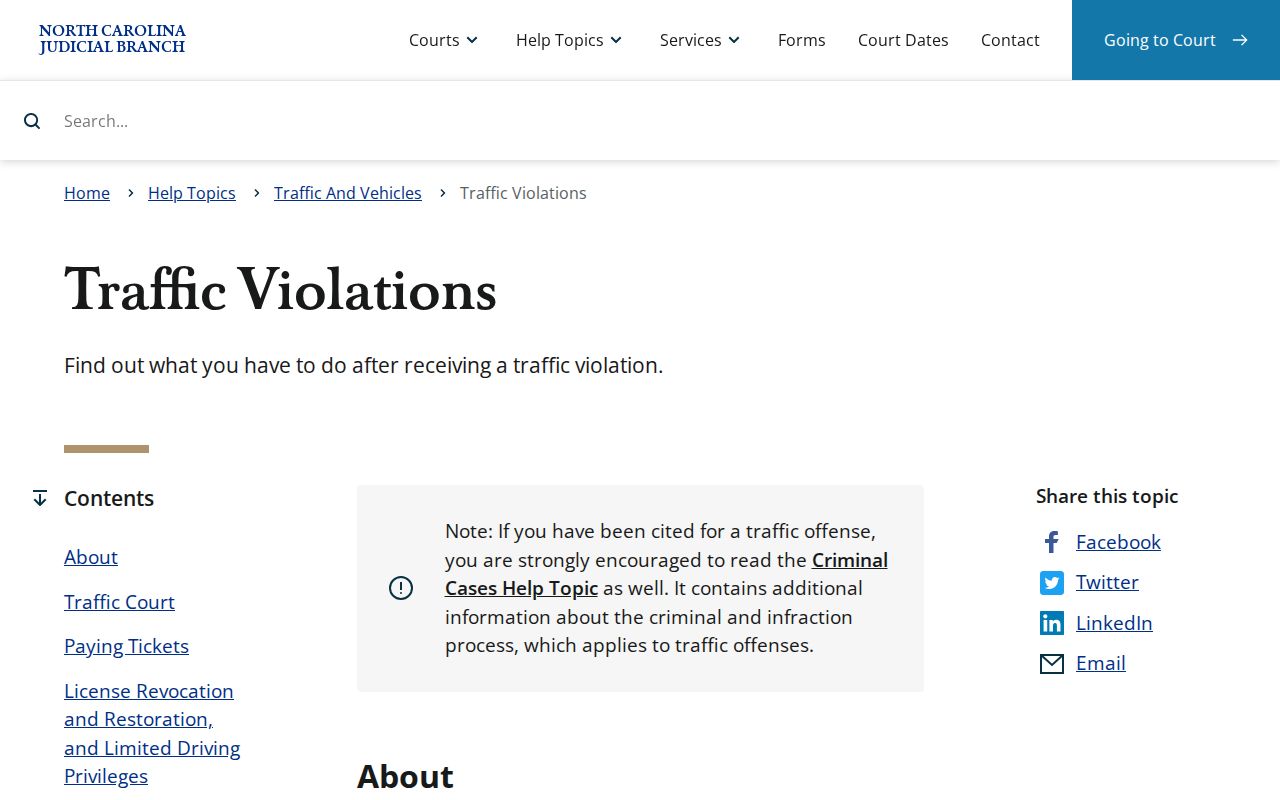
The state guidance handles the online-option route, and the Cleveland clerk is the local court-record contact.
Cleveland County Citation Search Routes
Match the search route to the question. Portal Smart Search gives the public Case Summary with visible status and history. Search Hearings and the criminal calendar serve a planned setting. Citation Services tells you whether a specific ticket has an online option. That may be a waiver, reduction, or dismissal request. For court-record clarification and eligible payment details, turn local. The clerk and Cashier's Office are the local routes.
| Route | Use it for | Important boundary |
|---|---|---|
| Citation | County of charge, court date, charge, and stated instructions. | The citation’s own terms control. |
| Portal Smart Search | Public Case Summary and visible court history. | Restricted information remains restricted. |
| Search Hearings or criminal calendar | Expected date, court, session, and courtroom. | A scheduled setting can change. |
| Citation Services | Available online response options for that citation. | Availability is case-specific. |
| Cleveland clerk or Cashier | Local court record, eligible payment details, and clarification. | Staff cannot decide the case or give legal advice. |
Finding Your Traffic Court Date
Every traffic ticket carries a court date. Start with the citation. Then pull up the case in Portal and cross-check the Cleveland criminal calendar when a current schedule document is posted. The calendar shows a planned session, not a final result. It may include the court, session date and time, courtroom, case number, and a CHARGE line, so read each entry with that in mind.
| Citation or case number | Use the number printed on the ticket. A Portal-format reading aid is YY-CASE-TYPE-######-220; 220 is the Cleveland suffix observed on calendar material. |
|---|---|
| Court | Confirm the Cleveland District Court setting named by the citation or official result. |
| Date and time | Compare the citation, Search Hearings result, and current calendar when available. |
| Courtroom | Use the hearing or calendar field for the scheduled courtroom. |
| Case Events | Review the visible court-side history separately from the calendar schedule. |
If the setting is near, continued, or affects an appearance, confirm it with the clerk or the District 39 calendar-coordination route. An older calendar is never the final word.
Cleveland County Traffic Calendar Details
The Cleveland criminal calendar is a session document. It can list a courtroom, session date and time, case number, role or agency details, and the CHARGE field, which makes it handy for finding where a matter will be called. What it cannot do is settle anything. It does not show that a charge was resolved, that a hearing took place, or that a later Case Summary already reflects the result.
- Hearing
- A scheduled court proceeding; the listing does not itself reveal the outcome.
- Continuance
- A postponement of a scheduled setting to another date or session.
- Called and failed
- Traffic or criminal calendar language indicating that a person did not appear when the case was called.
Paying or Contesting a Ticket
Every citation has a court date, but the response route depends on the ticket itself. Some minor speeding or equipment offenses are marked waivable. The fine and costs can then be paid before the court date instead of appearing. Paying a waiver counts as a guilty or responsible outcome. Other citations require an appearance. Citation Services may offer online reduction or dismissal requests for qualifying matters. A request is never guaranteed to be granted.
| Response path | What it means | Where to verify |
|---|---|---|
| Eligible waiver or payment | May allow payment before the court date when the citation permits it. | Citation, Citation Services, Portal eligibility, or clerk. |
| Appearance or contest | Follow the citation and court instructions for the scheduled court process. | Citation, current hearing result, calendar, or clerk. |
| Online request option | May present a reduction or dismissal request for qualifying matters. | Citation Services determines availability for the ticket. |
Missed court date or payment: State traffic guidance says a person who does not appear may be marked called and failed. After 20 days, a Failure to Appear may be issued and reported to DMV; after disposition, failure to pay within the ordered time can lead to a report after 40 days. Current court notices and orders control the particular case.
Cleveland County Traffic Mail Payment Rule
Paying a Cleveland County traffic ticket by mail comes with one firm rule. The county payment information page says to send a money order or certified check made out to the Cleveland County Clerk of Superior Court. Cash does not belong in an envelope. Personal checks are out too. Remember that this mail route only covers how to pay; it says nothing about whether your citation can be waived or whether a court appearance is still required.
At the counter, the Cashier's Office takes more forms of payment. Cash works in person. So do credit or debit cards, though a processing fee applies, with Visa, Mastercard, American Express, and Discover named on the local page. A money order or certified check also works there. Before you pick any route, confirm your citation is eligible and get the exact amount owed from the Cleveland County payment information page, which spells out both mailing and counter instructions.
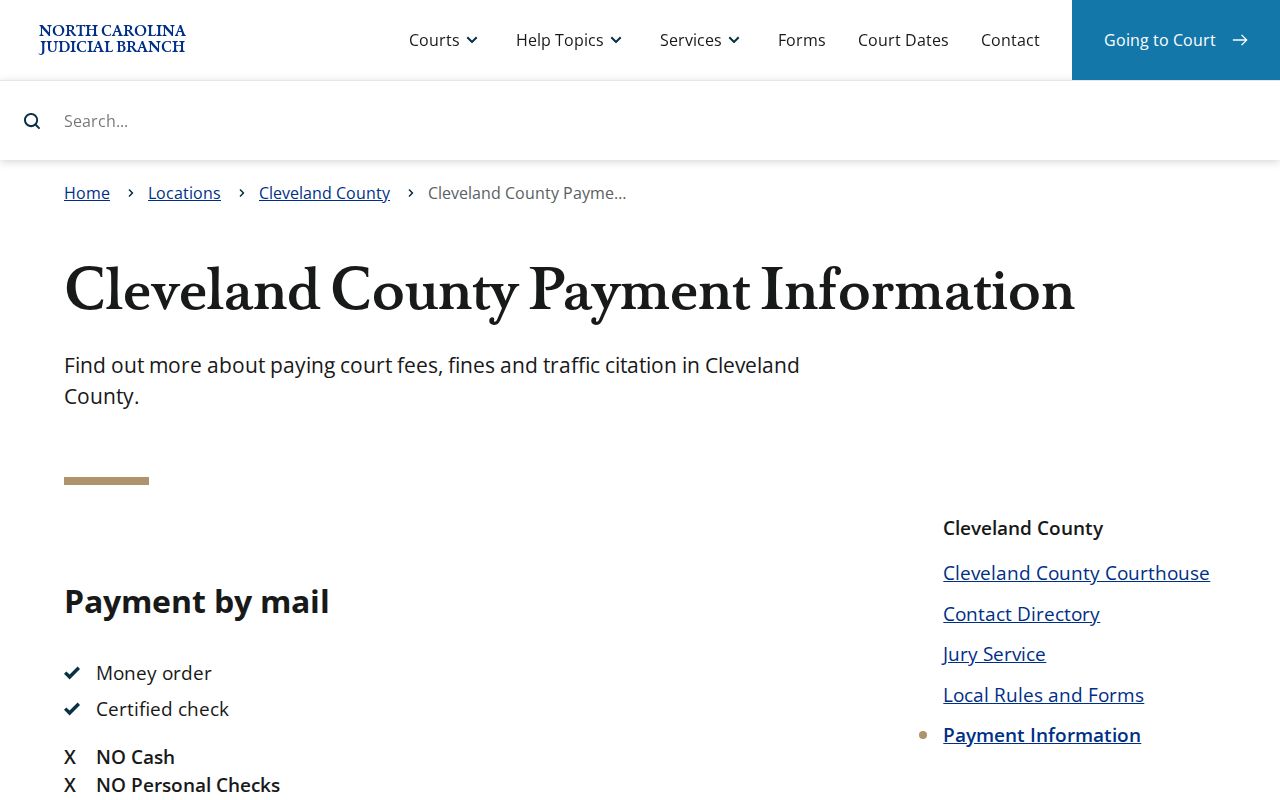
Every case is different, so read your citation alongside the clerk's current guidance before sending anything.
Court Traffic Record vs Driver Record
A traffic case leaves a paper trail in two places, and they answer different questions. The Clerk of Superior Court keeps the Cleveland court file, which tells the court-side story of a citation: the filing, the settings, the visible events, the disposition, and public court financial information. NC DMV keeps a separate licensing record. Ask the clerk when you need a court document from the case. DMV questions about license action go through NC DMV's official route instead.
| Record | Custodian | What it addresses |
|---|---|---|
| Court traffic record | Cleveland Clerk of Superior Court | The citation case, court dates, visible events, disposition, and public court-side financial information. |
| DMV licensing record | NC DMV | Licensing actions and the separate DMV record process. |
After a final court action the two records can connect, yet neither one can stand in for the other. A traffic court lookup should stay anchored to the court file and the current court date.
Cleveland County Traffic Record Custodians
One clerk holds the files. The Cleveland Clerk of Superior Court keeps District Court traffic files along with other county trial-court records. G.S. 7A-109 directs clerks to maintain those dockets, files, and indexes for public inspection during regular office hours unless law says otherwise. Portal is a lookup layer on top of that custody, not a substitute for it.
Access has real limits. Portal users cannot view sealed or confidential court records. Juvenile, unreturned-warrant, and other protected categories may stay off the public docket. A missing result proves nothing. It does not mean no record exists, and it is not a reason to go hunting for restricted material.
Fees and Copies
Cleveland's clerk posts no published fee schedule for plain or certified copies of traffic records. Ask the office directly before you request anything. Ask about copy costs, certification charges, and accepted payment methods. The state statute, G.S. 132-6.2, draws the line between certified and ordinary copies but sets no Cleveland clerk fees.
| Item | Fee finding | Boundary |
|---|---|---|
| Plain or certified Cleveland traffic copy | Local fee not located in official sources | Confirm availability and charge with the clerk. |
| Portal Make Payments service | 2.39 percent, with a $1 minimum | Only for eligible criminal financial obligations. |
| In-person card payment | Processing fee applies; amount not located | For eligible payment transactions at the Cashier’s Office. |
| Mail payment | Use the amount stated for the eligible case | Money order or certified check, not cash or personal check. |
Cleveland County Traffic Failure Rules
G.S. 20-24.1 sets the statewide framework for reporting certain failures to appear or pay. The 20-day and 40-day milestones in state guidance are general rules only. They cannot replace the citation, a court order, or a current DMV notice in your own case. If a date is closing in, confirm the court-side status. Use the citation, Portal, the calendar, and the clerk.
For the official reporting rule, the statutory failure-to-appear and failure-to-pay framework is the source the statute itself spells out.
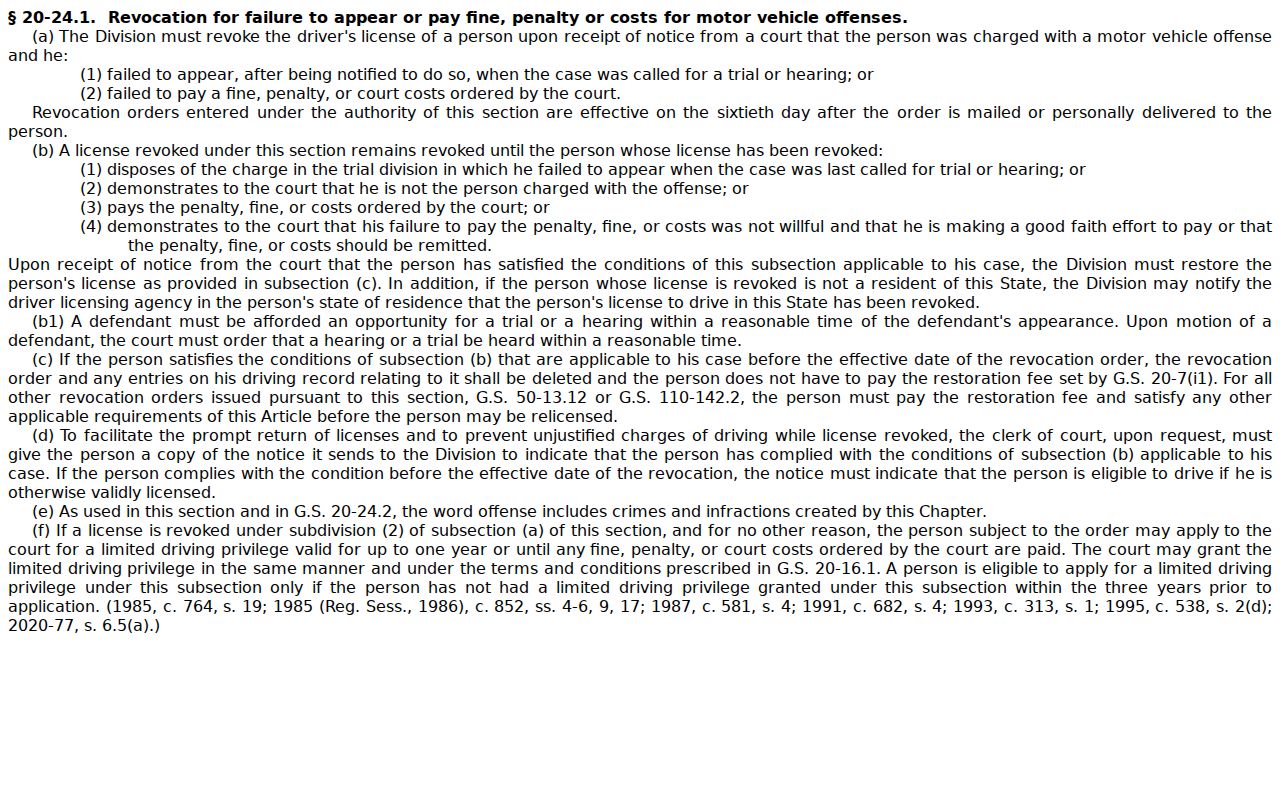
The statute explains how reporting works. The Cleveland case record and current notices tell you what actually happened in one matter.
Cleveland County Traffic Case Options
Deferral, reduction, and prayer for judgment continued are not automatic features of every Cleveland docket. State guidance is clear that these options vary by district, and a judge may grant a prayer for judgment continued only in some cases. For a question about your own situation, Citation Services, the court, or counsel is the right route. No Cleveland-specific public fee or eligibility schedule exists for these options.
That gap matters when you read an online docket result. A ticket can display a court date and visible case information while saying nothing about whether any particular option is open to you. Follow the actual citation and the court's current instructions. Never assume another traffic case supplies your rule.